Process of
Manufacturing
Unlike naturally found diamonds that are becoming rare and expensive, lab-grown diamonds are taking over the jewellery markets as they are available at an affordable cost and can meet high customer demands.
There are two prominent methods of growing diamonds in labs.
- HTPT (High Pressure/High Temperature Process)
- CVD (Chemical Vapor Deposition)
Although both HTPT and CVD are effective and popular methods used in engineering diamonds, CVD is more commonly used in producing gem-grade diamonds, while HTPT is used for creating diamonds for industrial purposes.
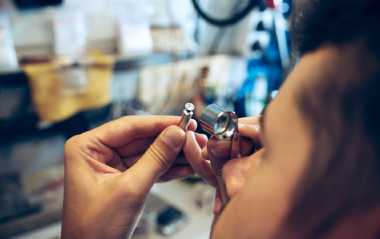
Lab-grown diamonds are created with the same physical, chemical and optical properties. The difference between natural and lab-made diamonds may not be visible to the naked eye, but gemologists may be able to identify them by close inspection.
All diamonds form in the cubic system.CVD diamonds have one direction of growth.
Here’s more about the process of diamond manufacturing.
The HTPT Process
HTPT is known as the first method used to synthesise diamonds. It was developed in 1950. The process entails using metal flux, small diamond seeds and a pure carbon material like graphite. These elements are put into a capsule where they are heated at high temperatures of 1,300ºC to 1,600º C under an atmospheric pressure of 59,200 atm. This leads to the dissolution of the carbon into the flux. This dissolved source is then passed through a metal mixture allowing the diamond seed to crystallise into an artificial piece of diamond.
HTPT diamond manufacturing uses three types of presses: the belt press, the split press and the cubic press. HTPT-generated diamonds undergo advanced heat treatment once they are out of the presses. This helps in the enhancement of the colour and carat of the diamonds. So with varying treatments, you can even create fancy coloured diamonds.
CVD Process
The CVD diamond manufacturing process entails using carbon, hydrogen and oxygen gases. These are pushed into a chamber with a substrate like a sleek silver with a diamond seed. Sometimes, graphite is also used. This chamber is heated at relatively lower temperatures, from 800º C to 900º C.
The energy from the heat source from lasers or hot filaments compels the carbon to precipitate from the gaseous mixture and stick to the graphite or silver used as a substrate to crystallise into a gem-standard diamond. CVD treatments can render the diamonds yellow or brown, which are then further treated with heat to be sold as white or colourless diamonds.
HTPT and CVD diamond manufacturing can take between hours to a week. The bigger the size of the diamond required, the longer the required time to process it.
Assuring the Best of 4Cs of Diamond Quality
We understand that you seek value when you buy diamond jewellery from our store. At
Carat Creations, we ensure that our customers are fully informed about the basic
characteristics of the diamonds they order, along with their price and value.
As the universal method of assessing the quality of diamonds is hidden in the 4Cs, i.e.
Cut, Clarity, Colour and Carat, here’s a glimpse of how we assure our clients the best
of all these criteria.
The quality of a diamond’s cut determines its radiance, and as per the GIA scales, it
ranges from Excellent to Poor. As cut is one of the most crucial of the 4Cs in diamonds,
we ensure that our workmanship quality remains uncompromised. Poorer cut grades in
diamonds appear relatively dull and lifeless.
Color is an important factor considered in measuring the quality of diamonds. Colourless diamonds usually contain traces of colours such as yellow, brown or grey. Lesser the color, i.e. the more colourless a diamond, the more valuable it is. There are 23 colour grades ranging from D to Z. Any diamond with a color beyond Z is referred to a different color scale.
As color grade impacts the diamond’s pricing and the first three color grade differences may not be easily traced by the naked eye, we ensure that the gradation is done by expert graders in a special environment.
The clarity of the diamond measures the absence of blemishes and inclusions in the stone. This is a measure of the purity and rarity of the stone that is graded by the placement and visibility of blemishes under a certain degree of power magnification. Diamonds with clarity grades of VS2 or SI1 may not have any visible inclusions and have a better value than diamonds with I1 or lower grades that may have more visible inclusions.
At Carat Creations, we provide a catalogue of diamonds with better clarity, as this also impacts the diamond’s durability.
Carat refers to the diamond’s weight. The higher the weight, the bigger the size of the diamond. The price of your diamond also largely depends on the carat weight. At Carat Creations, you can find a range of diamonds by varying carat weights.
Even if this is your first time buying diamond jewellery, you can rely on us because we have qualified trainers who can help you with the purchase process in simple language. Our store enables you to shop for diamonds from the comfort of your home, you can search for diamonds according to the 4Cs parameters and compare the prices to find a suitable piece.
History of Lab-Grown Diamonds
To understand your lab-grown diamonds better, you can look at their origin and track how they have emerged as one of the preferred choices. In the first instance, you might wonder whether or not to invest in lab-cultivated diamonds. Well, the introduction of these diamonds has undoubtedly impacted the traditional diamond industry and why not? Lab-grown diamonds look and feel the same as real diamonds, from their optical and physical properties to their chemical constitution. Moreover, the former is much more affordable than natural diamonds.
The origin of lab-engineered diamonds can be traced back to the 50s decade when General Electric (GE) first produced them. What you see today is a result of years of research and dedication of scientists around the globe.
It didn’t take researchers long after discovering diamonds to start brainstorming on creating synthetic diamonds. Such attempts were made as early as the 19th Century, although it was only in 1954 that GE confirmed its invention of lab-grown diamonds.
The ambitious project took flight in the 1940s but was put on hold owing to the growing threat and crisis caused by World War II. The process started taking shape after years of experiments involving varied methods, temperatures and different pressure mechanisms.
Small seed crystals were subjected to high-pressure belts under temperatures of 1,600º C and pressure of 100,000 atm. Advanced devices were used to dissolve graphite to pace the conversion of graphite to diamond. What was produced as a result had properties similar to that of naturally found diamonds. This included the ability to scratch and damage metal tools. Hence, scientists concluded that they had successfully created lab diamonds. Herbert Strong and Howard Tracy Hall were given credit for this marvellous discovery.
How Sophisticated Gem-Quality Diamonds Came Into The Market?
The diamonds produced by the GE labs proved to be a pathbreaking invention, but they were not suited for ornamental use. It was later, in 1971, that GE started creating higher-quality gem crystals. The company used advanced processes of employing pressure and heat techniques on graphite to generate diamonds.
Although this glorious discovery paved the way for diamonds, synthetic diamonds often turned out to be yellow and contained impurities. Such diamonds would be graded lower in their colour and clarity standards. While it was found that nitrogen in the gems would cause the yellow tint in the diamonds, further research led to the production of colourless diamonds.
Many countries didn’t take long to manufacture diamonds in their respective labs. In no time, the market saw lab-generated diamonds that flaunted higher carat, colour and clarity than their natural counterparts. GE also started using their HPTP(high pressure and high temperature) method to enhance the colour of diamonds.
The Latest Technology Used in Producing Lab-Grown Diamonds
While GE initially mimicked the underground natural diamond-forming technology in cultivating diamonds, this manufacturing process appeared expensive. Today, what you see in the market is made from a process known as CVD (chemical vapour deposition).
Diamonds created via CVD allow more control over the lab-grown diamond properties, enabling large-scale production and quality control. This method uses carbon gas that heats the diamond seed in a regulated chamber. This causes the carbon to attach to the seed and grow in size. With the refinement of the CVD process, gem-quality diamonds could be produced in bulk. Moreover, as CVD can also take place at lower pressures and temperatures, it can reduce the overall cost of production.